|
I am different. My concrete is actually waterproof for exactly the same reason as everyone else's. But I don't give you the heaps of crap you get from other waterproof concrete suppliers. My supervision is what makes the real difference. I don't allow the heaps of crap from the sub contractors either. I waterproof the actual concrete you use on site, I supervise to prevent errors and I often got samples tested at the lab to prove you use completely waterproof concrete.
I am different because I make sure the concrete is correct, I put the chemical in at site, I provide really good vibrating pokers and I supervise all the concrete going in.
My point is clear.
Except me.
Throughout the EU, concrete is made to BS EN 206-1 and hardened concrete is tested to BS EN 12390. Part 3 is the test for compressive strength. Part 8 is the test for impermeability. Your engineer will specify C35 or C40 etc.. That is the compressive strength of the concrete and part 3 is the test to prove that your concrete is adequately strong. To be classified impermeable, depth of penetration of water under 4 bar pressure maintained for 96 hours must average 20mm or less.
The concrete mix you will need to buy is
In 2011, the new edition of a long-respected university text stated more clearly than ever before that completely waterproof concrete could be produced without admixtures.
"concrete with a low water/cement ratio ... make the capillaries discontinuous"
|
|
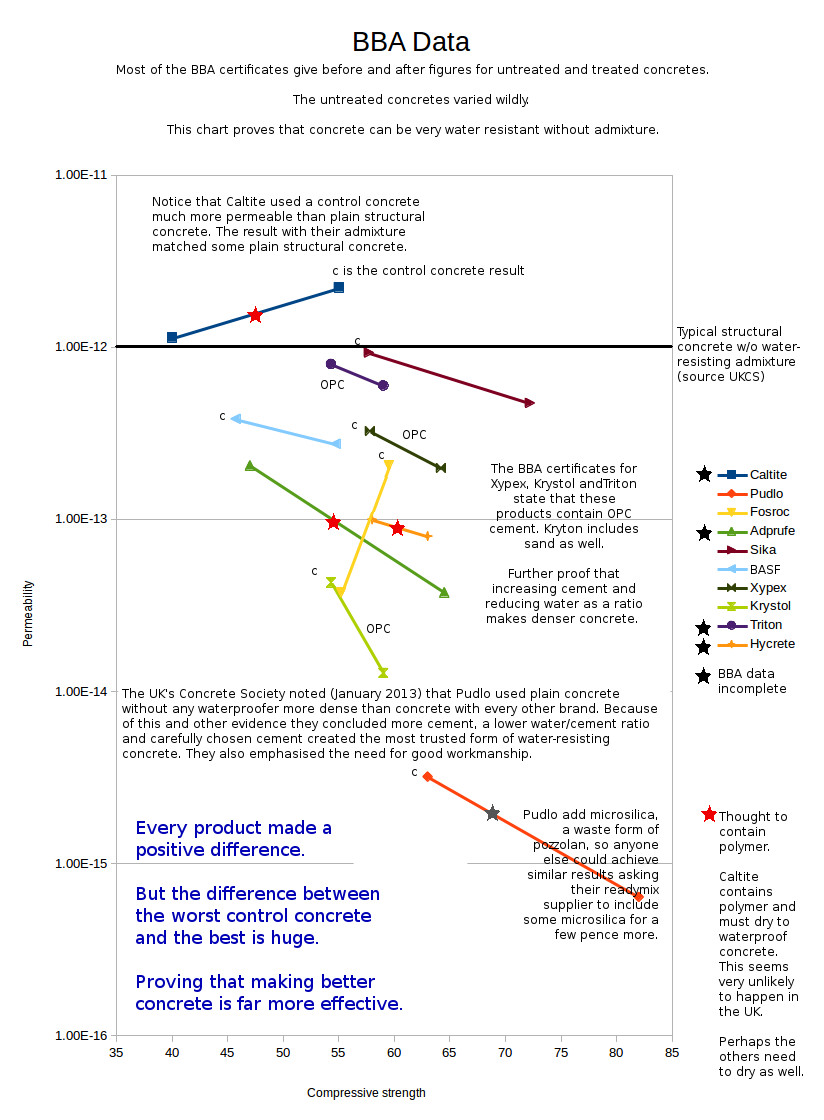
Here I have plotted the before and after figures for compressive strength and water permeability from the BBA certificates I found for water-resisting admixtures for concrete.
What is striking is how varied the results for concrete without admixtures and how limited, in comparison, the benefit of a water-resisting admixture. Some data was missing, such as Caltite compressive strength test results, so I have made up missing data with my educated guess. This chart proves how little difference all the water-resisting products make, compared to the huge difference that a better concrete mix design can make. The 'active' ingredient in Xypex, Krystol and Triton is only OPC. Cement. At about 100 times the usual cost. If you click on the chart it will open in a new window so you can print it. |
Have BBA conned you and not tested any of these concrete admixtures on site concrete?
To pump any concrete on site it needs a slump of at least 70mm. But the workforce would complain if the concrete was that stiff and add water (which would ruin any waterproofing and void any warranty) so concrete used on site needs a slump of at least 100mm.But as this chart of data from the various BBA certificates shows, most brands seem to have cheated in the lab, proving that they did not test concrete that would be used on a building site.
These are the quoted figures on these brands' BBA certificates for the slump in the concrete with the admixture after 30 minutes, which is about how long a truck takes to batch, drive to site and manoeuvre into position. I have also put the cement content for each and for C35A.
| Pudlo | Sika | BASF | Xypex | Kryton Krystol KIM | C35A | |||||||
| 45mm | 40mm | 135mm | 35mm | 45mm | ||||||||
| 350kgs | 350kgs | 350kgs | 325kgs | 325kgs | 325kgs |
Reminder. BBA testing of Caltite did not make any concrete more resistant than a plain structural concrete, neither did they quote as many figures on their certificate as the other brands shown above.
I used to buy from BASF before I went to Asia and bought the best available there. In my opinion, the slump figure for BASF - the only one tested in concrete that could be used on site - supports the science that a quality plasticiser is all that needs adding to high quality concrete to make it waterproof.
|
Caltite's guarantee, you will find one pictured on this web site here, guarantees that if their product fails they will put things right (but only to the value of their product).
But what does their product do? They don't say anywhere. Therefore no one could sue. They seem to guarantee only the product but they promote 'the system'. 'The system' includes concrete with extra sand and cement and less water. So 'the system' will work because the concrete works. Specifiers seem led to believe that the Caltite rep on site supervises. But on site the rep makes the foreman sign a disclaimer saying the Caltite representative was not there to supervise and Caltite is not responsible for workmanship. I have further information from Sika and Kryton as well. They aren't any better. Indeed the worst horror stories I heard over the years all involved Sika. |
Most specifiers think that the only way to get anything close to supervision is to buy a BBA certified water-resisting admixture.
|
We supply supervision and vibrating pokers that really work well. That way you know Supervision and good compaction will happen.
Please go the Basement Expert web site for details of the threaded fibreglass rods and nuts.
disclaimer and copyright